
The Elephant in the Room: Understanding How Will AI Replace Humans in Society
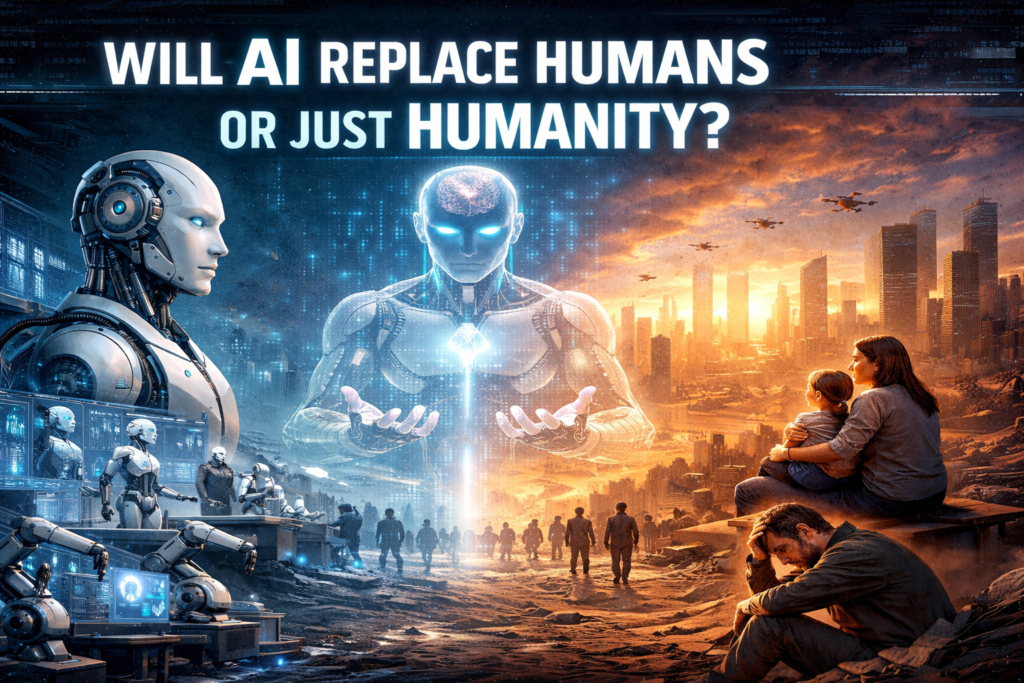
Artificial Intelligence, or AI, has become the go-to solution for every task. With the ease of life, AI has also raised a big question: Will AI replace humans? It is a question that has persisted since the emergence of AI. Yes, the AI revolution has opened windows for a whole new world. The world we could only imagine. But it comes with some serious complexities. Let’s discuss these complexities one by one.
The Overwhelming World of AI Tools
The first complexity is that the tools are overwhelming. What to learn and what not to learn, and how many there are. Although there are many AI platforms, they all perform similar tasks, with only slight differences. No matter how much you learn, you will always feel the need to learn more tools.
Convenience Turns into Overdependence
The overcrowding of technologies brings us to another complexity: overdependence. We are relying entirely on AI tools. We are not putting in the effort we used to. For example, writing or reading a human-written book feels connected to our mind and soul. But AI has replaced that writing, and now everyone is a writer. The human skills, however, still stand out.
Validation, and the Loss of Human Judgment
Another problem is validation; these AI systems are built to increase engagement. They tell you what you like. They validate and appreciate. Their views are subjective. You are only getting, in that sense, AI may replace those ‘buttering’ humans— people who say good things about you only for their own gains. They are not true friends. Likewise, AI is not a good friend; it is the friend that is currently making you dependent and then overpowering you.
The Illusion of Skill or Will AI Replace Humans in Reality?
The above example of writing with AI highlights another layer of complexity. The loss of effort is not limited to creative fields; it extends to technical fields as well. Today, Individuals can use coding-based analytical tools without formal coding training, largely due to AI assistance. While this enables experimentation and learning by errors, it comes with limitations. The errors are frequent, and the process takes longer. An expert with formal training could often achieve the same outcome in less time.
Furthermore, the impression of competency is a heightened form of dependence on AI. A lack of formal training will leave you short-handed. And the validity and accuracy of these things remain questionable.
Education, Expertise, and What AI Cannot Replace in Humanity
This illusion contributes to another complexity, the decreased value of education and skills. In the era of AI, people are replacing education with AI tools. AI creates an illusion that people could excel in every area, but that is not a real skill. The real expertise of humans lies in their education, interests, and skills. Humans created AI to make life easy.
Challenges Ahead: Will AI Replace Humans?
Humans were supposed to use the AI; nonetheless, humans began to be used by the AI. This is ironic: the thing we created for ease has made our lives more complicated.
So, to answer the question: will AI replace humans? Yes, if this goes on as it is. Though not in a literal sense, it will make the human lose humanity and human intelligence. Humans will be humans, but may act as puppets of these tools. Humans will not be replaced literally, but humanity’s existence is questionable.
I am not against using AI tools, but the blind use of them is harmful. I recommend using AI as an assistant, not to replace thinking, learning, and effort.
To explore these ideas in more depth, especially on AI and human judgment in research, check out my book Artificial Intelligence in Social Science Research, available on Amazon.
Also, check out my blog, Union Budget 2026: Built on Fundamentals and National Strengths, for more reflections on important topics shaping our world and our thinking.
Leave a Reply